What is SaaS Product Development? (2026) Complete Guide: MVP, Pricing, Tech Stack & Scaling
SaaS (Software as a Service) is one of the most powerful business models in 2026. Instead of selling software one time, SaaS companies sell access to software through subscriptions—monthly or yearly. Customers use the product online, and the SaaS provider continuously improves it.
But building a SaaS product is not the same as building a “website” or a “one-time software project.” SaaS product development is a structured process that includes:
- choosing the right problem
- designing a product that users keep using
- building an MVP quickly
- launching and learning fast
- improving onboarding and retention
- scaling performance, security, and infrastructure
- managing subscriptions and customer success
This guide explains SaaS product development in a practical, business-friendly way, including how SaaS products are built, what stages they go through, what tech stacks are common, how pricing works, what metrics matter, and how to avoid common mistakes.
1) What is SaaS? (Simple Meaning)
SaaS = Software delivered over the internet, paid as a subscription.
Instead of installing software on a computer, the user logs in through a browser (or mobile app) and uses it online.
Examples:
- Google Workspace
- Zoom
- Shopify
- Notion
- Slack
- CRM systems
- billing/invoicing software
- inventory management portals
Key characteristics of SaaS
- user accounts and login
- a hosted platform (cloud)
- subscription plans (monthly/yearly)
- ongoing updates and features
- customer support and success
- scalable infrastructure
2) What is SaaS Product Development?
SaaS product development is the end-to-end process of building a subscription software product, including:
1) Idea validation (problem selection) 2) Requirements and MVP planning 3) UX/UI design + user flows 4) Engineering build (frontend, backend, database) 5) Deployment + monitoring 6) Subscription and payments setup 7) Onboarding and retention improvements 8) Scaling, security, and product iteration
SaaS is a living product. It never finishes after launch. You continuously measure, improve, and expand.
If you want SaaS and web application development services, explore: Web Applications Services
3) SaaS vs Custom Software vs Website (Important Difference)
SaaS product
- built for many customers
- subscription billing
- strong onboarding and retention
- multi-tenant architecture (usually)
- constant updates and support
Custom software for one business
- built for one client
- may not need subscriptions
- limited users
- fewer product-market-fit experiments
Website
- mostly informational pages
- goal: trust and leads
- may include forms or basic features
SaaS is more complex because it must work reliably for many customers and be easy to adopt.
4) How SaaS Product Development Lifecycle Works
A good SaaS roadmap follows stages:
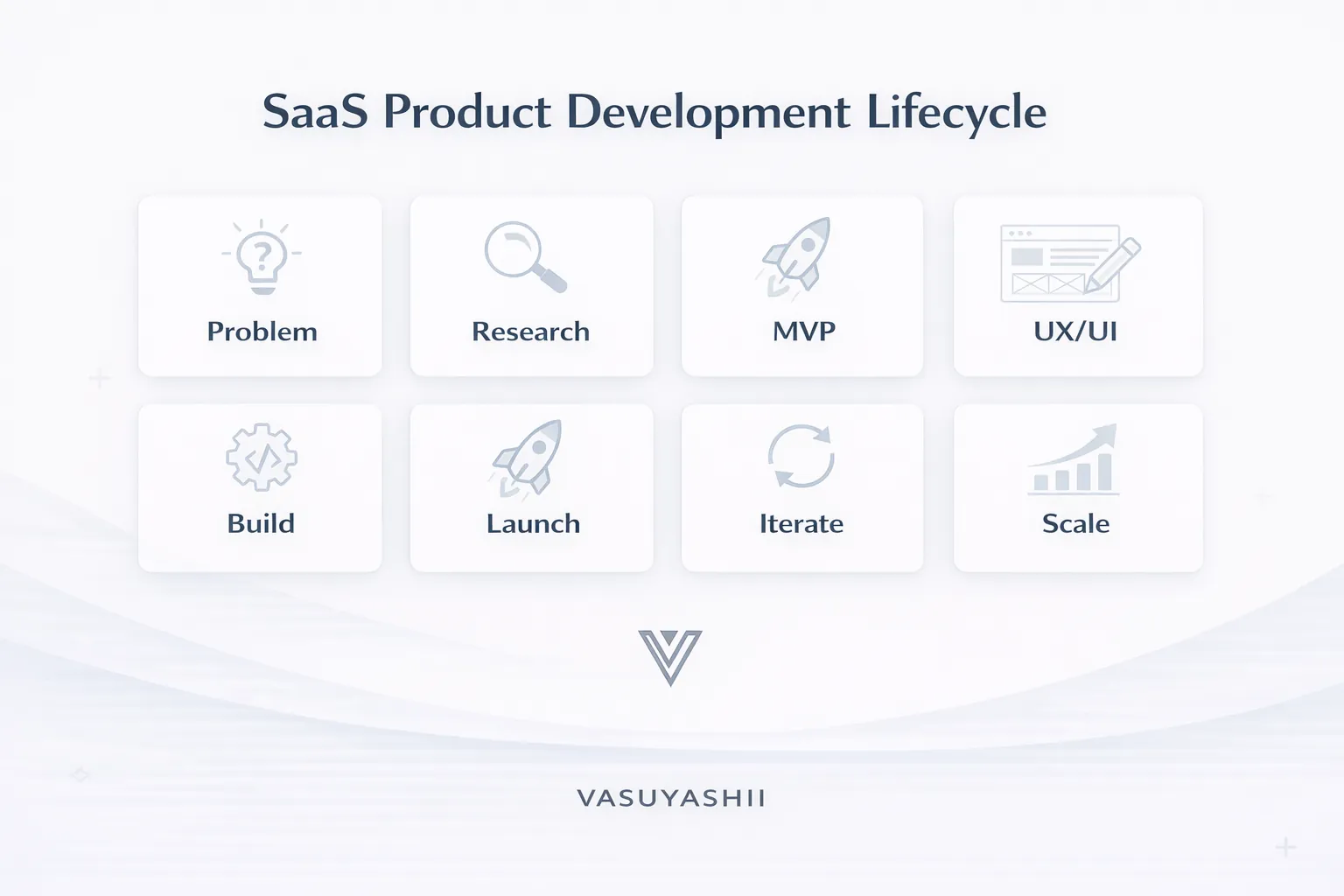
Stage 1: Problem selection
Pick a problem with:
- clear pain
- willingness to pay
- repeating usage need
- a specific user persona
Stage 2: Market research
Validate:
- competitors exist (good sign)
- what users like/dislike about them
- the best niche angle you can win on
Stage 3: MVP definition
MVP is a minimal version that solves the core problem fast. MVP is not “cheap product.” It’s focused product.
Stage 4: Build and launch
Launch quickly to real users.
Stage 5: Iterate to product-market fit
Improve based on feedback and usage.
Stage 6: Scale
Once retention is strong, scale users and infrastructure.
5) MVP in SaaS (Most Misunderstood Part)
What MVP means
MVP = Minimum Viable Product A version that is viable enough that users can actually use it and pay (or at least commit to using).
What MVP is NOT
- a full product with every feature
- a half-broken demo
- an app with 20 modules but no clarity
SaaS MVP must include
- clear onboarding flow
- core feature works end-to-end
- basic dashboard
- user account system
- basic billing (optional initially)
- analytics tracking
Rule: Build fewer features, but make them solid.
6) Multi-Tenant vs Single-Tenant (SaaS Architecture)
Most SaaS products are multi-tenant, meaning:
- many customers use the same system
- but each customer’s data is separated
Example:
- Company A logs in and sees their data
- Company B logs in and sees their data
Multi-tenant benefits:
- easier to maintain one codebase
- cheaper hosting per customer
- faster feature rollout
Single-tenant means each customer gets separate deployment or database, which can be used for enterprise use cases but costs more.
For most SaaS startups, multi-tenant is the default.
7) Core Modules of a SaaS Product (Common Building Blocks)
Most SaaS products share similar modules:
A) Authentication + account system
- signup/login
- password reset
- email verification or OTP
- session management
B) User roles and permissions
- owner/admin
- manager
- staff
- viewer
C) Organization / workspace
- company profile
- team invites
- team management
D) Billing and plans
- free trial
- monthly/yearly plans
- plan upgrades/downgrades
- invoices
E) Product core module
This depends on what your SaaS does (CRM, inventory, reporting, etc.)
F) Admin dashboard (internal)
- customer list
- usage and billing
- feature flags
- support tools
8) SaaS Pricing Models (How SaaS Makes Money)
Common SaaS pricing models:
1) Per user pricing
Example: ₹499/user/month Best when value grows with team size.
2) Tiered plans
Example: Starter, Pro, Business Best for most SaaS.
3) Usage-based pricing
Example: per order, per API call Best for developer tools, automation tools.
4) Freemium
Free basic plan, paid upgrades Works only when product has strong viral or low-cost users.
Tip: Start simple. Tiered pricing is easiest initially.
9) Tech Stack for SaaS Product Development (2026)
A modern SaaS stack often looks like:
Frontend
- Next.js (React)
- Tailwind CSS
- component libraries (optional)
Backend
- Firebase (fast MVPs)
- Node.js + Express/Nest (custom APIs)
- Python (data-heavy systems) (optional)
Database
- Firestore (NoSQL, fast to start)
- PostgreSQL (best for reporting, relational data)
Auth
- Firebase Auth
- Auth.js
- custom JWT sessions (advanced)
Hosting
- Vercel (frontend)
- cloud functions/serverless (backend)
- cloud database
Payments
- Razorpay (India)
- Stripe (global)
The right stack depends on:
- speed of development
- complexity of reporting
- future scaling needs
10) SaaS Security (Must-Have)
SaaS stores customer data. Security is critical.
Must-have security practices:
- HTTPS everywhere
- secure auth and session handling
- role-based authorization
- input validation (server-side)
- rate limiting (prevent abuse)
- secure secrets management
- backups and monitoring
If you want security best practices: Website Security Best Practices
11) SaaS Metrics That Matter (How You Know You’re Winning)
SaaS is a numbers game. You must track:
Acquisition metrics
- website traffic
- conversion rate
- CAC (customer acquisition cost)
Activation
- signup to first meaningful action
- onboarding completion rate
Retention
- daily/weekly active users
- churn rate (cancellations)
- cohort retention
Revenue metrics
- MRR (monthly recurring revenue)
- ARPU (avg revenue per user)
- LTV (lifetime value)
If retention is weak, scaling marketing will waste money.
12) Onboarding and Retention (The SaaS Secret)
The best SaaS products win because users succeed quickly.
Improve onboarding by:
- simple signup
- guided setup (3–5 steps)
- empty state UI (what to do first)
- tooltips and walkthrough
- sample data option
Reduce churn by:
- product clarity
- email notifications
- helpful reporting
- good customer support
- continuous improvements
A SaaS that is easy to use becomes a habit.
13) Common Mistakes in SaaS Development
Avoid these mistakes:
1) Building too many features before MVP 2) No clear target user 3) Weak onboarding 4) Not tracking metrics 5) Poor role permissions and security 6) Ignoring performance 7) No customer feedback loop 8) Pricing too complex initially
14) A Practical SaaS Build Roadmap (90 Days)
Days 1–7: Discovery
- pick niche + persona
- competitor research
- define MVP scope
Days 8–21: Design
- user flows + wireframes
- UI system + mobile experience
- define data model
Days 22–45: Build MVP
- auth + roles
- core module
- basic dashboard
- basic notifications
Days 46–60: Launch
- early users
- bug fixes
- onboarding improvements
Days 61–90: Iterate
- retention improvements
- pricing tests
- add 1–2 features based on real usage
This roadmap is faster and safer than trying to build everything at once.
Need SaaS Product Development Help?
If you want to build a SaaS product (MVP → launch → scale) with clean architecture, speed, security, and subscription-ready setup, VASUYASHII can help.
👉 WhatsApp: Chat on WhatsApp 👉 Services: https://www.vasuyashii.com/services/web-applications 👉 Portfolio: https://www.vasuyashii.com/portfolio 👉 Contact: https://www.vasuyashii.com/contact