Progressive Web Apps Explained (2026): What Is a PWA, Benefits, Use Cases & Setup Guide
A Progressive Web App (PWA) is one of the most practical technologies for businesses in 2026. It gives you an “app-like” experience using a website—without forcing users to download an app from the Play Store or App Store.
You might have seen “Add to Home Screen” on some websites. When a user adds your site to their home screen, it opens like an app, feels faster, and can even support offline mode (depending on the setup). That is a PWA.
PWAs are popular because they:
- feel like mobile apps
- are cheaper to build than native apps (Android/iOS)
- are easy to update (users always get the latest version)
- can work offline (or partially offline)
- can support push notifications (with limitations depending on platform)
This guide explains PWAs in a simple, business-friendly way, including how they work, what features they support, when you should use them, and how to set up a PWA for your website or web application.
Quick Definition: What Is a PWA?
A PWA is a website that:
- can be installed on a phone (Add to Home Screen)
- opens in a standalone app-like window (no browser UI)
- uses caching (Service Worker) to load faster
- can support offline mode for certain pages
- can send push notifications (supported more strongly on Android)
In short: PWA = website + app-like experience.
Why PWAs Matter in 2026
1) People hate downloading apps
Many users don’t want to install a new app for every business. PWAs reduce friction.
2) Faster experience improves conversions
PWAs use caching, so repeat visits can feel very fast.
3) Lower development cost
Instead of building:
- Android app
- iOS app
- and a website
You can build one PWA that covers most use cases.
4) Great for business systems
PWAs work well for:
- ordering systems
- dashboards
- inventory apps
- CRM-style tools
- booking portals
If you build web apps and portals, explore: Web Applications Services
PWA vs Website vs Mobile App (Simple Comparison)
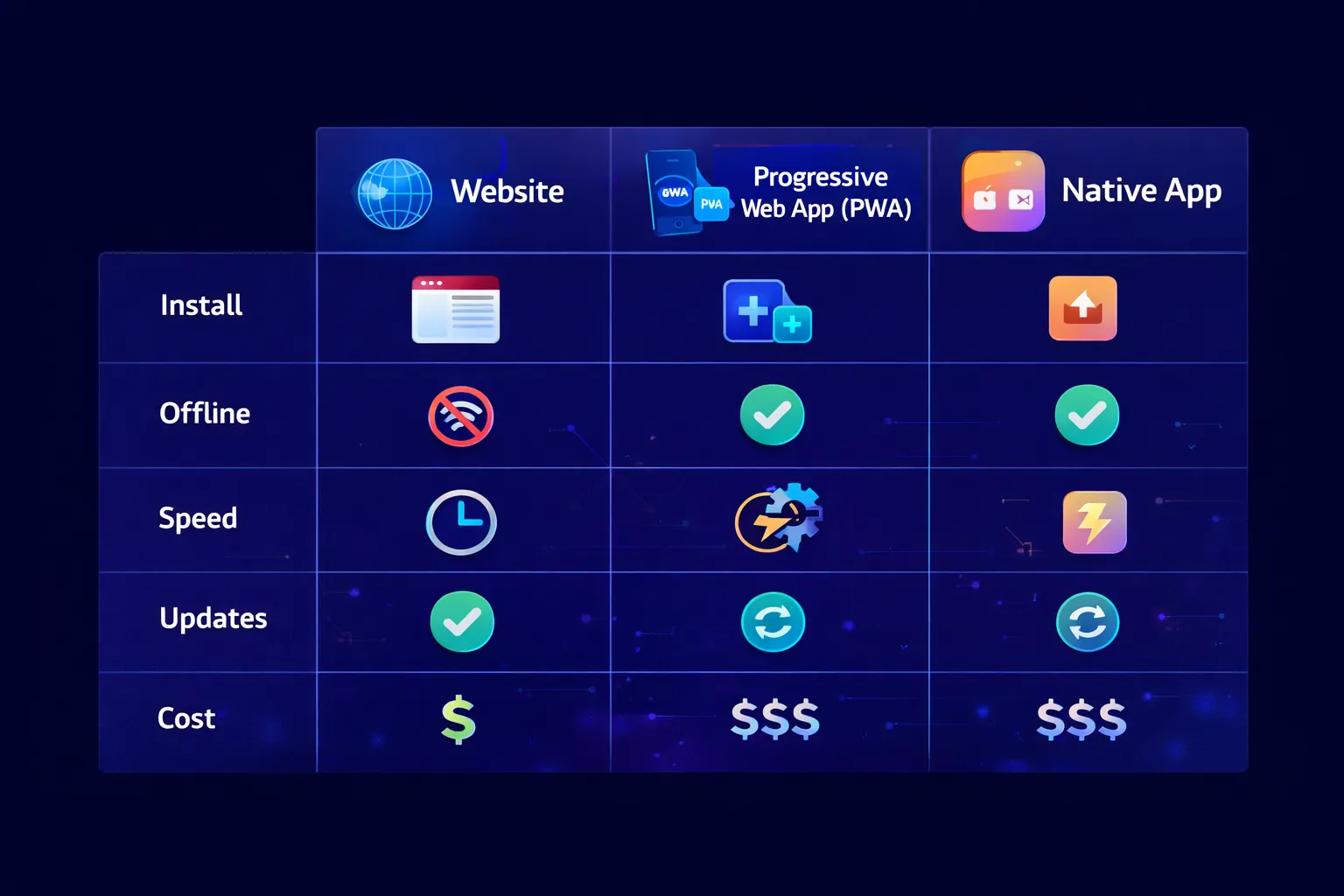
Normal website
- opens in browser
- no install prompt
- limited offline support
PWA
- installable
- faster repeat visits
- can work offline (partially)
- app-like UI
Native mobile app
- full device access
- best performance
- highest cost
- app store downloads required
Most businesses start with PWA before native apps.
How PWAs Work (Simple Explanation)
PWAs usually require 3 things:
1) HTTPS (SSL)
PWAs require secure connection.
2) Web App Manifest
A manifest.json file tells the browser:
- app name
- icons
- start URL
- theme colors
- display mode (standalone)
This enables installability.
3) Service Worker
A service worker is a background script that can:
- cache files and pages
- intercept requests
- enable offline behavior
- speed up repeat loads
The service worker is the heart of PWA performance and offline features.
Key Features of a Progressive Web App
1) Installable (“Add to Home Screen”)
Users can add your web app to their home screen and open it like an app.
2) Standalone display
It can open without the browser address bar, making it feel like a real app.
3) Offline support (optional)
You can cache important assets and pages so the app works even without internet—at least partially.
4) Faster repeat visits
Caching makes future loads faster.
5) Push notifications (platform dependent)
- Android: strong support
- iOS: improving, but rules and limitations exist
- Desktop: generally supported in modern browsers
6) Background sync (advanced)
Some PWAs can sync data in the background when connection returns.
Best Use Cases for PWAs (Businesses)
PWAs are best for:
1) Restaurant ordering systems
Customers use their phone at the table. PWA avoids app install friction.
2) Inventory and billing dashboards
Owners and staff can use it like an app on mobile.
3) Field staff apps
Simple tasks: checklists, reports, data entry.
4) Customer portals
Order tracking, account management, booking status.
5) SaaS products
PWAs are great for SaaS because web is the default platform.
Where PWAs Are NOT Ideal
PWAs may not be ideal for:
- heavy gaming apps
- apps requiring deep device access (Bluetooth, advanced sensors)
- complex background tasks on iOS
- app store distribution needs (some businesses want store presence)
If you need full device features, native apps might be better.
PWA Benefits for SEO and Marketing
SEO advantage
PWAs are still websites, so:
- pages can be indexed by Google
- you can publish blogs and rank
- organic traffic can bring installs indirectly
Marketing advantage
- users can open instantly from a link
- no app store barrier
- faster conversions
Many businesses use PWA as a “middle path” between website and app.
PWA Setup Guide (Practical Steps)
Below is a business-friendly setup checklist.
Step 1: Make sure your site is HTTPS
If your site is already on HTTPS, good.
Step 2: Create manifest.json
Include:
- name + short_name
- icons (multiple sizes)
- start_url
- display: standalone
- background_color and theme_color
Step 3: Add icons
You need icons like:
And ideally maskable icons.
Step 4: Add Service Worker
Start simple:
- cache essential assets
- cache app shell
- add offline fallback page (optional)
Step 5: Test installability
Test in:
- Chrome Android
- desktop Chrome
Step 6: Optimize caching strategy
Choose strategy:
- Cache First (for static assets)
- Network First (for dynamic content)
- Stale While Revalidate (balanced approach)
Step 7: Add push notifications (optional)
If your use case needs it, implement notifications carefully.
PWA Caching Strategies (Easy Explanation)
Cache First
- app loads fast
- uses cached content first
- best for static assets
Network First
- always tries latest data
- falls back to cache when offline
- best for dashboards and dynamic pages
Stale While Revalidate
- shows cached immediately
- updates in background
- best balanced experience
PWA and Performance (Core Web Vitals)
PWAs often improve performance because:
- cached assets load quickly
- repeated visits become faster
But performance still depends on:
- image optimization
- script size
- heavy UI components
You should still follow speed best practices: Website Speed Optimization Guide
Security Considerations for PWAs
PWAs require secure practices:
- use HTTPS always
- validate inputs server-side
- protect APIs
- secure authentication
- proper access control (roles)
PWAs are not “less secure” by default—they depend on your backend security.
PWA for Your Business: Should You Build It?
Use PWAs when:
- you want app-like feel without native cost
- you want faster repeat users
- your users are mostly mobile
- you need offline support for basic flows
For many service businesses, even a normal responsive website is enough. But for systems like ordering, portals, inventory, PWA is a great upgrade.
A Practical Plan (PWA Rollout)
Phase 1: Make website installable
- manifest + icons + basic service worker
Phase 2: Cache important pages for speed
- app shell caching
- offline fallback
Phase 3: Advanced features
- push notifications
- background sync
- offline data storage
Need a PWA Built for Your Business?
If you want a Progressive Web App for your ordering system, dashboard, portal, or SaaS product, we can build it professionally.
👉 WhatsApp: Chat on WhatsApp 👉 Services: Web Applications Services 👉 Portfolio: View our work 👉 Contact: Contact page
FAQs
1) Are PWAs better than mobile apps?
They are not “better,” but they are cheaper and easier for many businesses. Native apps are better when you need deep device features.
2) Can a PWA work offline?
Yes, partially. It depends on what you cache and how you design the offline behavior.
3) Do PWAs support push notifications?
Yes on Android and desktop. Support varies on iOS depending on device and browser constraints.
4) Do PWAs help SEO?
They can, because they are still websites and can be indexed. But SEO depends on content quality and technical setup.
5) Is PWA good for restaurant ordering?
Yes. It’s one of the best use cases because users can open instantly via QR without installing an app.