
March 29, 2026
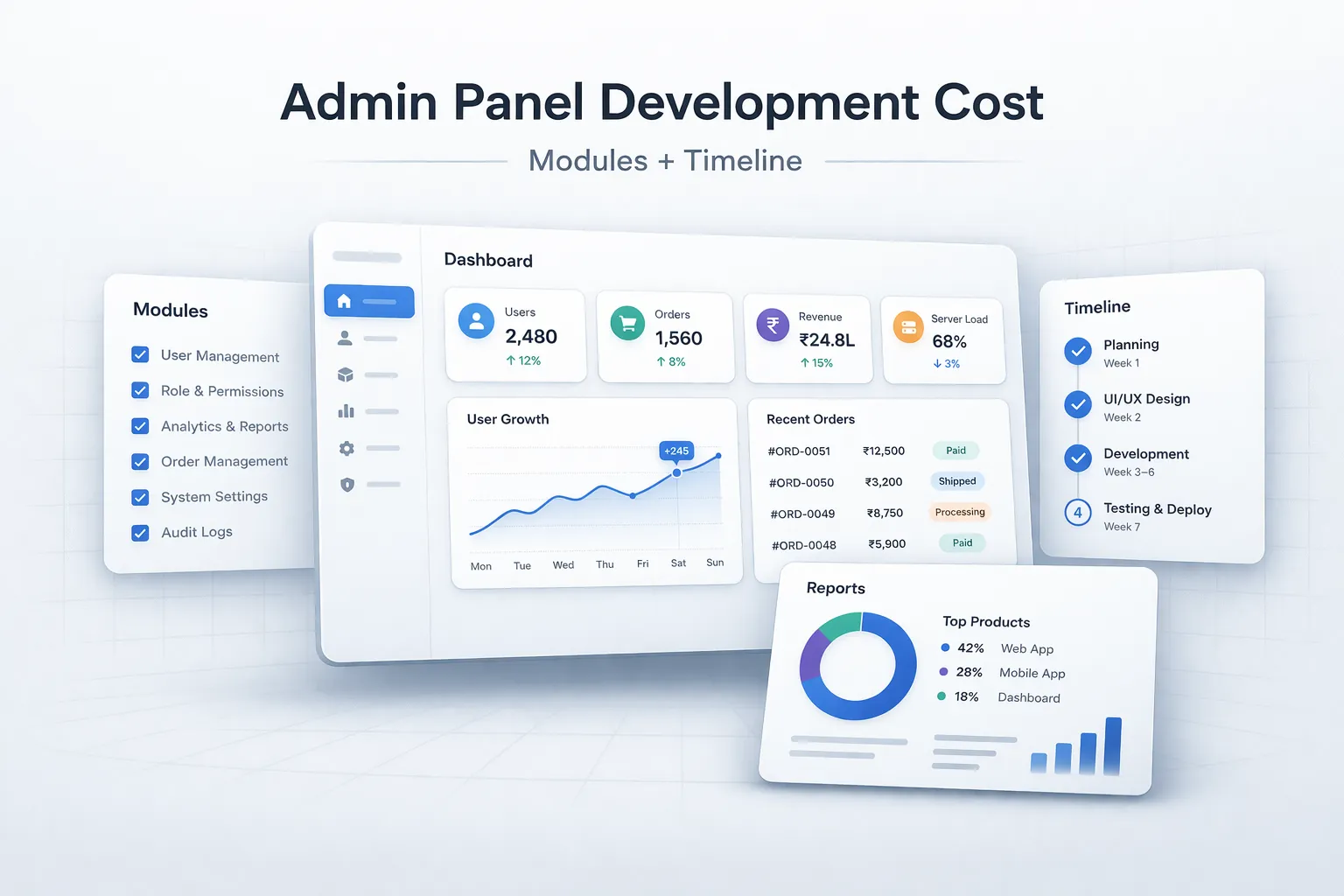
Admin Panel Development Cost (2026): Modules, Timeline, and What to Scope First
Admin panel development cost in 2026: modules, timeline, pricing ranges, dashboards, reports, roles, and what businesses should scope first.
Read articleMarch 28, 2026
Software development company in Delhi NCR: pricing, process, deliverables, timelines, and how businesses choose the right partner in 2026.
If you are searching for a software development company in Delhi NCR, you are probably not looking for "just code." You want a team that can understand the business problem, turn it into a practical scope, and deliver software that your staff can actually use daily.
That is the real difference between a random vendor and a strong development partner. In NCR, many companies promise apps, portals, ERP, CRM, dashboards, automation, and integrations. But the real question is simpler: who can ship the right software without wasting your budget or creating a maintenance headache after launch?
This guide explains pricing, process, deliverables, timelines, and how Delhi NCR businesses should evaluate a software development company in 2026.
For most Delhi NCR businesses, the best software development partner is not the cheapest one. It is the one that can scope correctly, build in phases, document the work, and support changes without turning every update into a new project.
Typical custom software in NCR usually falls into these ranges:
₹1.2 lakh to ₹3 lakh₹3 lakh to ₹9 lakh₹9 lakh to ₹25 lakh+If your need is primarily browser-based operations, web application services are usually the right starting point.
Custom software is not for every business. A standard SaaS tool is often enough when your process is common and your team can adapt to a fixed workflow. But custom development becomes valuable when the business loses time or money because existing tools do not match the way work actually happens.
That is why discovery matters so much. Good software companies do not start with features only. They start with workflow clarity.
In Delhi NCR, most software projects come from practical operational pain, not theory. The common requests are easy to recognize.
Businesses want one place for leads, tasks, documents, status tracking, approvals, and reporting. This often becomes a CRM-like system, admin dashboard, or workflow app.
Some companies need outside users to log in, upload data, track requests, or download documents. In those cases, permissions, audit logs, and usability matter more than flashy UI.
Teams often ask for payment, WhatsApp, email, ERP, inventory, or API integrations. This is where a strong software company helps most because integrations create a lot of hidden complexity.
Owners in NCR usually want daily clarity: what is pending, what is delayed, what is selling, who is responsible, and where money or effort is leaking. If the reporting layer is weak, the software never feels complete.
Related reading:
Many buyers compare software proposals only on price. That is a mistake. Two vendors may quote the same amount and deliver very different levels of quality.
The best software companies also define what is not included. That sounds small, but it prevents scope confusion later. A clean proposal should tell you what features are phase one, what is optional, and what changes price.
Software pricing depends less on city hype and more on scope, roles, integrations, data structure, and testing depth. Still, Delhi NCR buyers usually want realistic commercial guidance before they start discussions.
₹1.2 lakh to ₹3 lakhBest for small admin panels, request systems, approval flows, and limited user roles.
₹3 lakh to ₹6.5 lakhGood for CRM-lite, inventory systems, service dashboards, order tracking, or process automation.
₹6.5 lakh to ₹12 lakhSuitable for multi-role software with reports, alerts, document handling, and basic integrations.
₹12 lakh to ₹25 lakh+Used when the system includes mobile access, API integrations, complex permissions, or multi-branch logic.
Ask for a phase-one build that solves the biggest bottleneck first. Most businesses waste money when they try to build every future feature on day one.
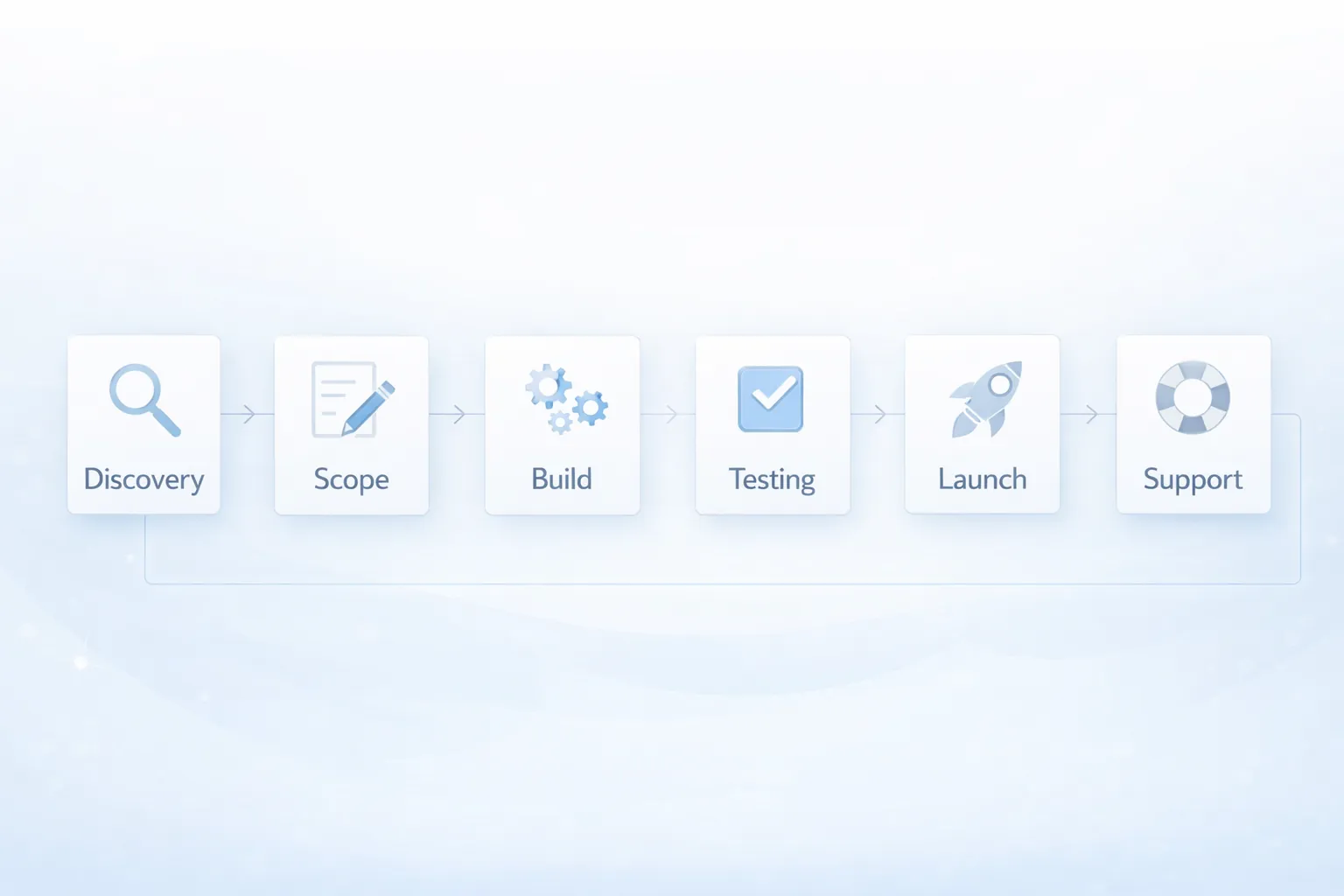
A good process protects both sides. It gives the client visibility and gives the development team a stable way to ship.
This stage turns verbal pain points into screens, modules, user roles, and reports. If discovery is weak, the build will feel expensive later because too many things get corrected mid-project.
The company should define what will be built now, what is optional, and what depends on third-party systems. This is the stage where realistic delivery happens.
Even simple software benefits from visual planning. Owners understand wireframes faster than technical notes.
A practical team shows progress during the build instead of disappearing until the end. Demo-based development builds trust and catches process mistakes early.
User acceptance testing is where businesses usually discover missing edge cases. The right vendor expects this and plans for it.
Launch is not only pushing code live. It also includes environment setup, basic training, and post-launch support.
If you already know your team is losing time because systems are fragmented or manual, it usually means the business is ready for a scoped custom solution.
The right stack depends on the product type, but for most business software projects a modern web stack is the most efficient choice.
Next.js for admin portals, dashboards, and role-based interfacesNode.js for workflow logic, APIs, and integrationsPostgreSQL for structured business data and reportingFor mobile-heavy use cases, mobile apps services may be added later or alongside the web platform.
Most custom software projects in NCR follow a phased timeline.
Smaller internal tools move faster. Larger role-based platforms with integrations take longer.
These are the biggest drivers behind custom software pricing:
The biggest cost mistake is unclear ownership inside the client team. When nobody can approve workflow decisions quickly, the project slows down and the budget gets pressure.
Before you sign, ask practical questions.
You do not only need pretty screens. You need proof the team understands operations.
If a company says yes to everything instantly, that is not always a positive sign. Strong teams challenge weak requirements and improve them.
In custom software, slow communication destroys momentum. Ask who will own requirements, demos, and support.
Software without support quickly becomes stale. Even a good build needs small fixes, upgrades, or adjustments after launch.
Small systems may start near ₹1.2 lakh, but practical business software usually sits in the ₹3 lakh to ₹9 lakh range depending on scope.
Many MVPs take around 6 to 10 weeks. Complex systems can take longer if roles, reports, or integrations are heavy.
Only when the business has specific workflows that SaaS cannot support properly. Otherwise SaaS can still be the better choice.
At minimum: scope, screens, tested build, deployment, and support window. Better vendors also provide documentation and training guidance.
For most internal business operations, web software is the better starting point because it is faster to build and easier to manage.
Most do, but the scope differs. Ask about bug-fix windows, AMC, response times, and change request pricing clearly.
Yes, and that is usually the smartest path. Start with the highest-impact workflow, then expand based on real usage.
Approving a vague scope because the price sounds low. That almost always becomes expensive later.
If you want custom software that is practical, scalable, and easier for your team to adopt, the right next step is a scoped discussion around process, modules, and rollout.
Related Articles
March 29, 2026
Admin panel development cost in 2026: modules, timeline, pricing ranges, dashboards, reports, roles, and what businesses should scope first.
Read article
March 28, 2026
Ecommerce website developer in Delhi NCR: packages, setup steps, pricing, timeline, and what online stores should launch first in 2026.
Read article
March 28, 2026
Local SEO for service businesses in Delhi NCR: step-by-step process, pricing, tools, and how to rank for city-based searches in 2026.
Read article